Protecting Your Woods: A Minnesota Landowner’s Guide to Managing Emerald Ash Borer
In the forestry world, we often deal with slow, predictable cycles of growth and decay. For Minnesota woodland owners, the arrival of the Emerald Ash Borer (EAB) feels like a ticking clock and has fundamentally changed the tempo. With over one billion ash trees in our state—the largest concentration in the country—the stakes are high. However, "doing nothing" is a decision that often leads to the permanent loss of your forest cover. Our landscape is facing a transformation that requires active, informed management rather than passive observation.
Trying to stay ahead of any and all invasive plants/organisms seems like an insurmountable hurdle for any landowner, that’s why at Holzfaller, we believe in management that is logical and simple. We understand the "pain points" landowners face: overly technical government manuals or the paralyzing fear that cutting trees will "ruin" the woods. This guide cuts through the noise, offering a logical strategy to identify the threat, mitigate the damage, and plant a resilient future forest.
Here is what you need to know to identify the threat, mitigate the damage, and transition your woods to a resilient future.
1. Identification: How to Spot the Borer
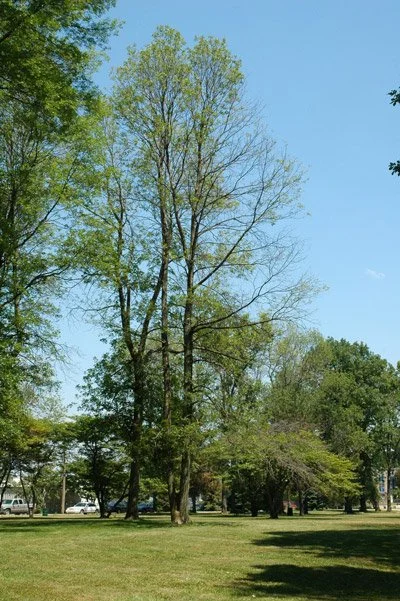
Early detection is difficult because EAB starts in the upper canopy. By the time you see symptoms at eye level, the tree has often been infested for 2–3 years.
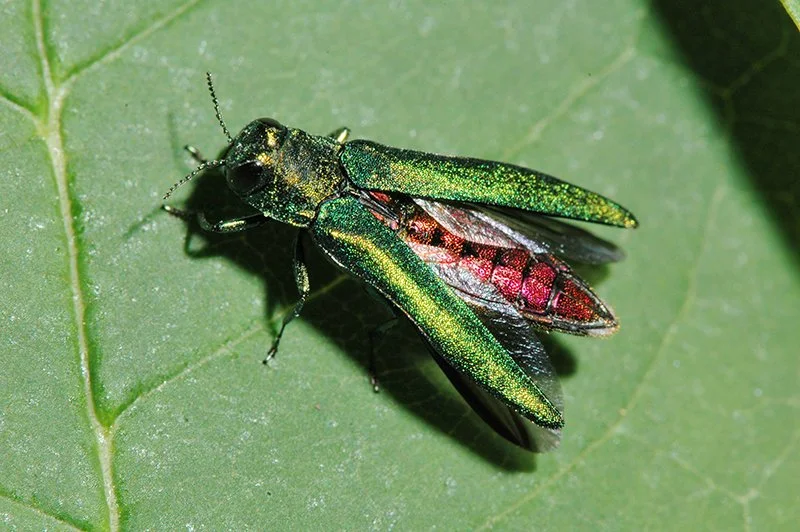
The Adult Beetle: These are small (1/3 to 1/2 inch long), slender, and a bright iridescent emerald to coppery green color. They are characterized by a flattened back and a metallic red abdomen visible under their wings.
The Larva: Found in the outer 1 inch of bark/wood, the larvae are creamy white, legless, and approximately 1 to 1-1/4 inches long. They have distinct, bell-shaped body segments and two tiny, spine-like projections called urogomphi at the tail end.
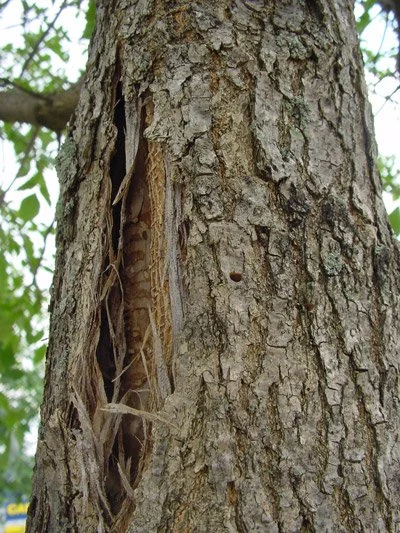
Woodpecker "Blonding": This is often the first sign. Woodpeckers strip away outer bark to get to larvae, leaving bright, light-colored patches.
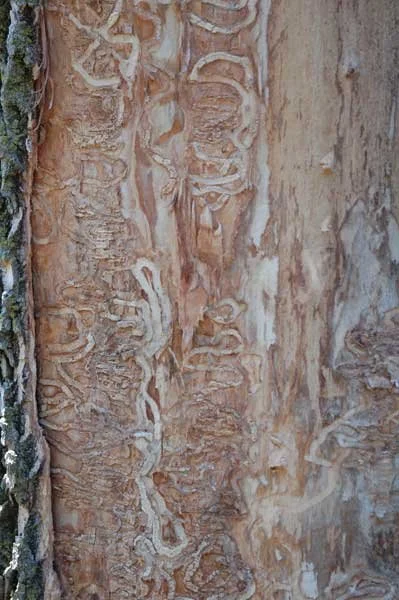
S-Shaped Galleries: If you peel back a bit of bark, you will see winding, serpentine tunnels packed with sawdust. This is the definitive "smoking gun" for EAB.
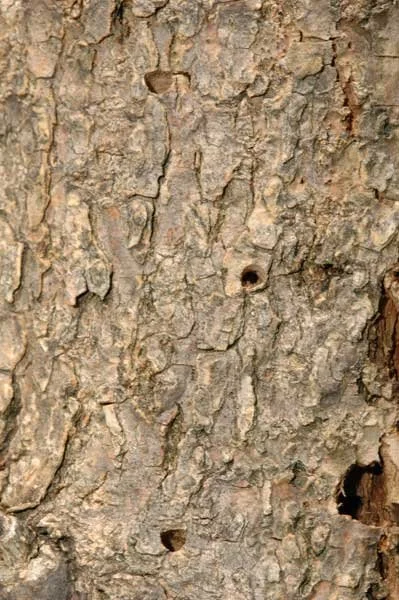
D-Shaped Exit Holes: Adults leave tiny (1/8 inch) holes shaped like a capital "D" when they emerge in June or July.
Epicormic Sprouting: Stressed trees will grow "suckers" or leafy clusters at the base of the trunk or at the crotch of large branches as a last-ditch effort to survive.
Landowners often confuse EAB with the native Bronze Birch Borer or Two-lined Chestnut Borer, which also create D-shaped holes but never attack ash trees. EAB targets only true ash species (Fraxinus); it does not affect Mountain-ash, which is a different genus.
2. Prevention: Don’t Give it a Ride
The natural spread of EAB is slow—adults usually fly less than half a mile. The "jump" to your woods usually happens through human help.
The Firewood Rule: Never move firewood across county lines. Buy your wood locally where you plan to burn it.
Timing Your Work: Avoid pruning or harvesting ash from May through September. This is "flight season" when beetles are active and looking for new hosts.
3. Mitigation: Capture Value and Protect the Site
If you have ash-dominated woods, you have two primary goals: capturing the timber value before it's gone and preventing "swamping."
Capturing Timber Value
Once an ash tree is infested, it becomes brittle very quickly. This significantly reduces its safety for loggers and its economic value at the mill. If you have mature ash, the most logical move is to conduct a harvest before the beetle arrives.
Avoiding the "Swamping" Trap
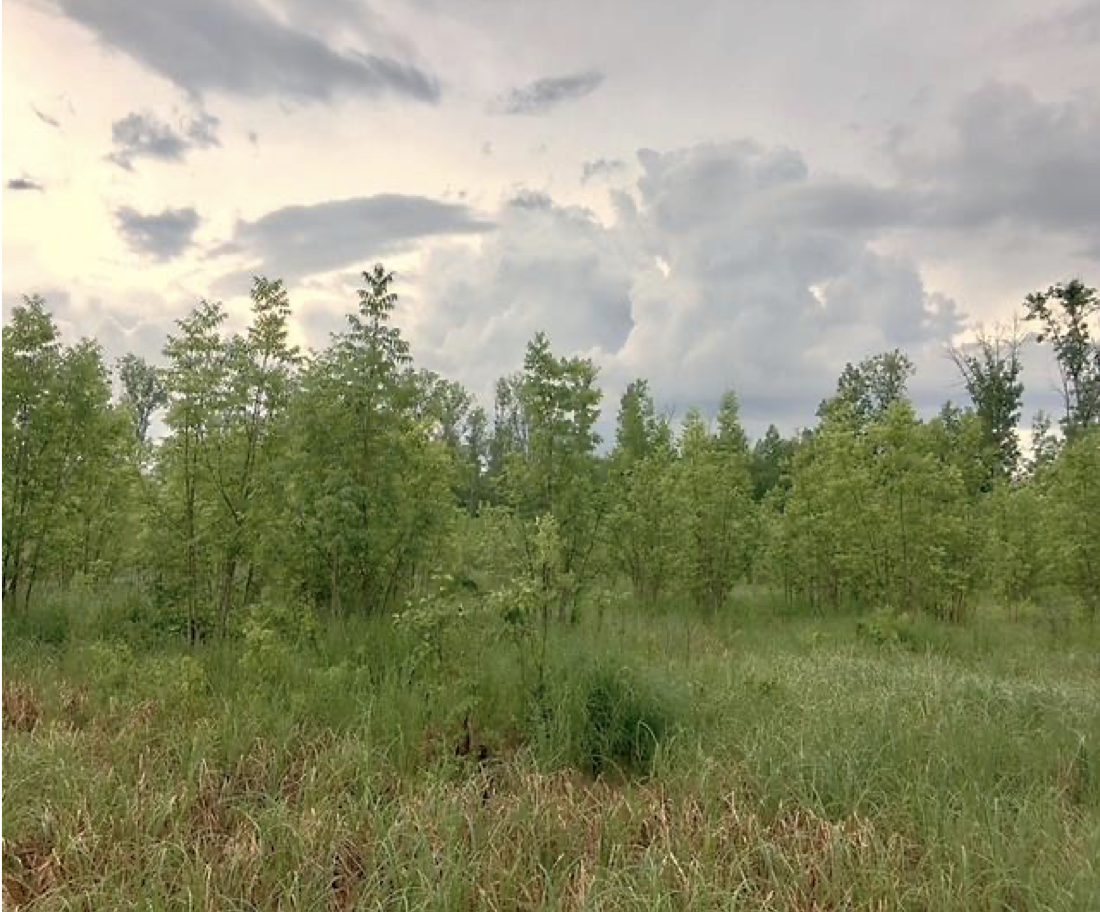
In many Minnesota wetlands, both black and green ash act as biological pumps, keeping the water table down through transpiration. Black ash can account for 40% to 80% of total site evapotranspiration, keeping the water table regulated If you clearcut these stands—or if the EAB kills them all at once—the "pump" stops. The water table rises to the surface, and the site "swamps" out, turning into a permanent marsh of cattails and speckled alder where trees may never grow again.
The Holzfaller Strategy: Avoid clearcutting on wet sites. Use Group Selection (harvesting in 0.1 to 0.5-acre gaps) or Strip Shelterwoods. This keeps enough living trees on-site to maintain the water table while you get the next generation of trees established.
The Solution: Use Group Selection (harvesting in 0.1 to 0.5-acre gaps) or Strip Shelterwoods. This maintains enough living tree cover to keep the site dry while you get new species established.
Diameter-Limit Thinning/Cut: DBH cuts have for a long time been controversial due to the likelihood of “High Grading” i.e. removing only the largest and best quality trees. Doing a DBH cut that is inverted or focuses on smaller diameter trees allows you to keep larger trees to be the biological pumps still and makes room for underplanting.
Single-Tree: Another lesser used practice in Minnesota except in high-quality hardwoods. Single tree is just what its name suggests, single tree marking or removing only the marked trees. This can be combined with Group selection and Diameter-Limit Thinning to grab individual trees already infested, at risk, or at the their maximum timber value prior to infestation.
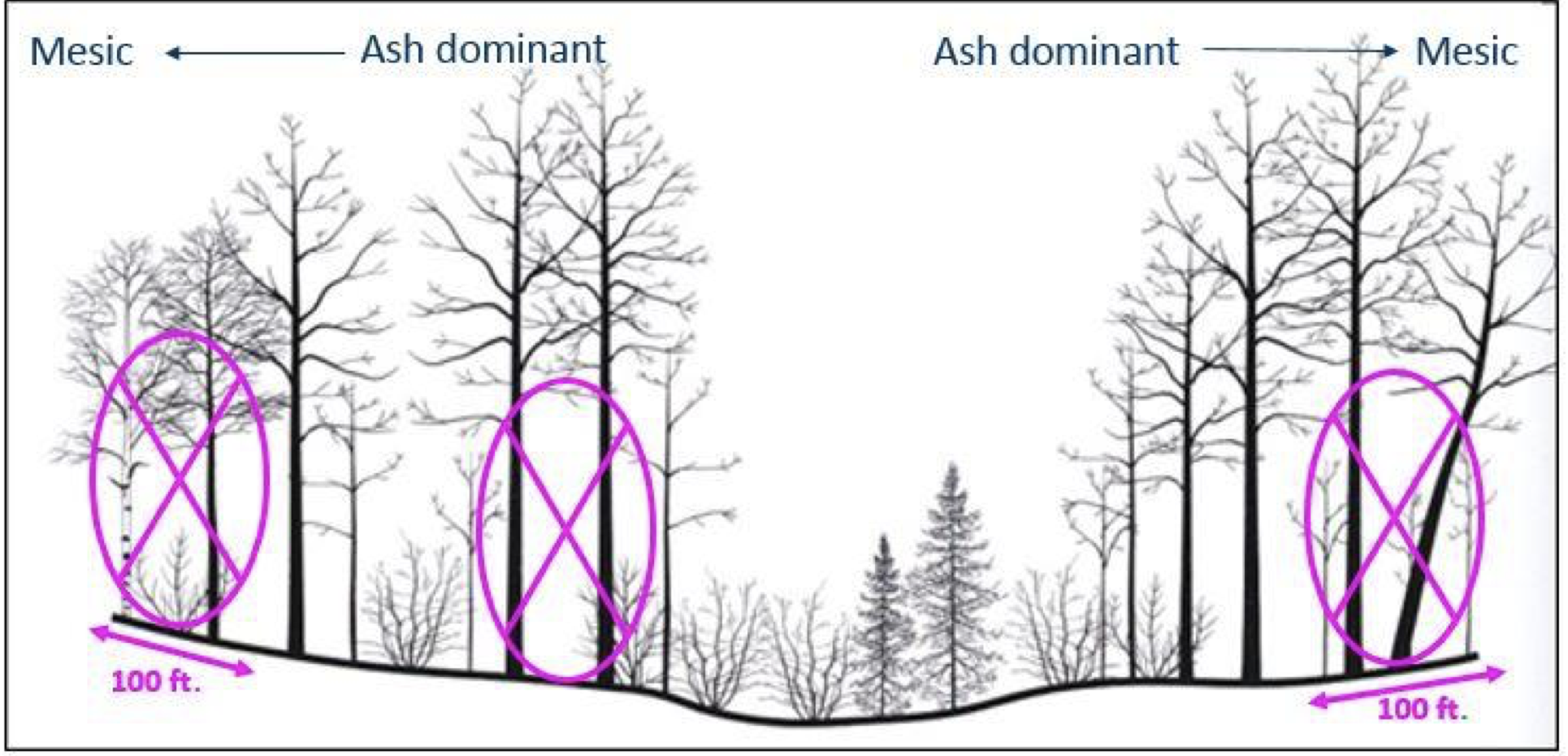
Strip-Thinning of Ash stand, the “X” denote where additional strips are located for removal as well as width removal of the strip.
4. The Future Forest: What to Plant Now
Research from the Northern Research Station (USFS) and the Great Lakes Silvicultural Library has identified several "climate winners" that can replace ash and handle the wet feet of Minnesota's swamps.
According to long-term survival studies, these species show the most promise:
American Elm: Specifically disease-resistant varieties (like 'Valley Forge'). These have shown survival rates as high as 81–93% in group selection trials.
Swamp White Oak: A major "climate winner" that maintains the hydrologic pump and provides excellent wildlife mast. It has shown 70–90% survival in underplanting trials.
Silver Maple: Extremely high survival in very wet sites; outpaces grass competition., showing survival rates over 90% in some Minnesota case studies.
Balsam Poplar: High Growth, Shows the fastest relative diameter and height growth in transition harvests.
Hackberry: 50% - 76% survival, performs well in group selection; an important wildlife food source.

Your Action Plan
Inventory: Know what percentage of your woods is ash. If it’s over 20%, you need a plan.
Monitor: Check your trees every spring for blonding and canopy thinness.
Underplant: Don't wait for the trees to die. Planting "climate winners" beneath your existing ash canopy now gives them a multi-year head start.
Use Cost-Share: Programs like EQIP and Minnesota DNR’s Field to Forest can reimburse up to 75% of your planting and site prep costs.
Consult: Work with a professional to bundle your ash harvest with other species to make the sale merchantable.
Managing EAB isn't about "saving every tree"—it's about ensuring your land remains a forest for the next generation. If you’re ready to start your inventory, let’s get into the woods.
References & Field Case Studies
The strategies in this guide are based on real-world outcomes from practitioners and researchers across the Lake States:
Great Lakes Silviculture Library: An open-access hub for Lake States foresters to share results from on-the-ground management.